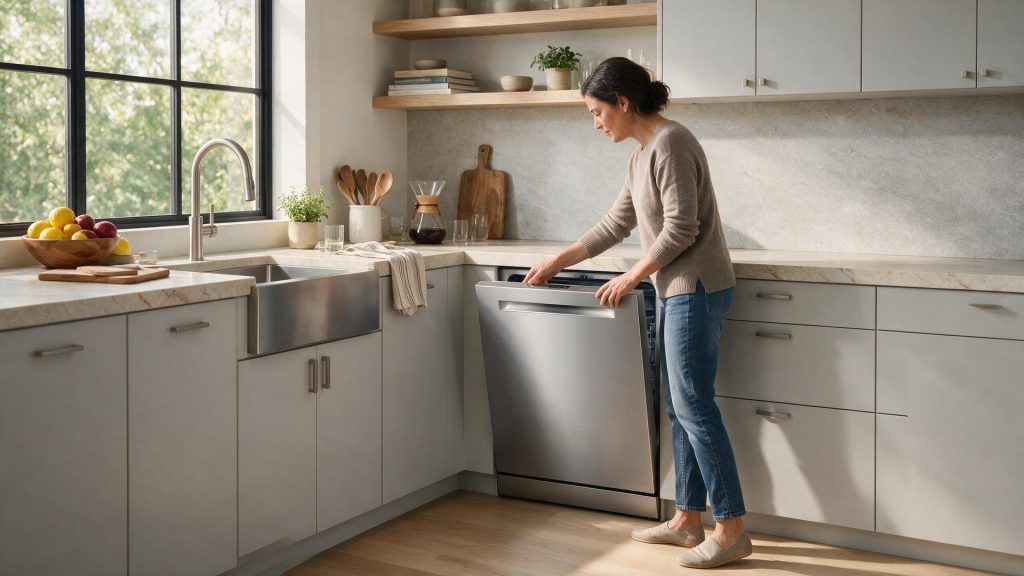
Visible water or an LC-style leak indication should be treated as a containment problem before it becomes a parts problem. Stop additional water and avoid repeated cycles until the source is understood.
With a Samsung dishwasher leak or an LC message, stop the water and protect the floor and electrical area before looking for a cause. LC on many Samsung models means the leak sensor detected moisture, even when no leak is visible, so a dry floor does not rule it out. If water reaches wiring or an outlet, keep the dishwasher off until it is checked.
Visible water or an LC-style leak indication should be treated as a containment problem before it becomes a parts problem. Stop additional water and avoid repeated cycles until the source is understood.
| Symptom | What it can point to | What you can safely check |
|---|---|---|
| LC or LE with water on the floor | A real leak from a hose, door seal, spray path, or detergent suds | Wipe up the water, run a new cycle to see if it returns, and shut off power at the breaker |
| LC or LE with no visible leak | Moisture the leak sensor can still detect | Check the supply hose, the disposer cap on a new install, and whether detergent is overfilled |
| Dishwasher turns itself on and tries to drain | The leak-error behavior Samsung describes | Cut power at the breaker |
| Water at the door after the cycle | An unlevel dishwasher or a misaligned door seal | Check level, and push the seal back into its channel |
Samsung dishwashers use several diagnostic families across generations. Public Samsung guidance commonly distinguishes water-supply, drain, leak, motor, vane, and heating conditions on supported models. The cycle stage—fill, wash, drain, heat/dry, or control/start—is essential context.
An LC indication narrows the investigation toward leak detection on supported Samsung dishwashers, but it does not identify one seal, hose, pump, or valve by itself.
Samsung’s leak page starts by wiping up the water and running a new cycle. If it does not reappear, it was a spill. Check these in turn: the supply hose, the door seal, the detergent, the level, and the spray nozzles.
Hoses come first. The water supply hose is sold separately and not covered by service, and Samsung recommends a 3/8-inch stainless steel hose because plastic hoses leak more often. If the door seal has slipped out of place, push it back into its channel and clean it with a towel and mild soap. A damaged seal needs service.
Detergent matters too. Use dishwasher detergent only, not dish soap, since excess suds can escape and cause leaks. Food debris in spray nozzles and jets can also cause leaks, so clean them as the manual describes.
If water reaches a junction box, outlet, wiring, or control area, keep the dishwasher off until both the leak source and electrical safety are addressed.
Other stop-use conditions include smoke, sparking, burning electrical odor, repeated breaker trips, persistent gas odor, uncontrolled overheating, violent mechanical movement, or water contacting electrical connections.
Do not bypass safety devices or perform live electrical, internal gas, sealed-refrigeration, induction-power, or microwave high-voltage work as a homeowner.
Samsung says LE or LC means moisture is detected where it should not be, even if no leak is visible. The dishwasher can turn on by itself, refuse to turn off, and try to drain. Cutting power at the breaker or unplugging stops that behavior, which otherwise continues until the moisture is gone.
Samsung lists these checks: the supply hose, the disposer cap if the disposal was recently connected, and whether detergent was overfilled or placed outside the dispenser, because leftover detergent stays moist and can trigger the sensor. If the unit was recently moved, let water near the underside sensor dry.
Samsung says to level the dishwasher side to side, so the door does not bump the cabinets, and front to back, so water does not pool at the door. For built-in units it also gives the tub opening at the cabinet screws as exactly 22 inches, with loosening the cabinet screws if it is wider.
Write down:
– the complete Samsung model code, including a suffix such as `/US`, `/AA`, or `/A3` when the product label includes one;
– the appliance type and installation style;
– the exact symptom in one sentence;
– when it began;
– whether it is constant or intermittent;
– what related function still works normally;
– any displayed code, message, light pattern, or warning before reset;
– any recent power, water, gas, drain, venting, cleaning, filter, or installation event.
Leave built-in, stacked, laundry-hub, or tightly fitted appliances installed unless the service team specifically requests access. Moving an appliance without a plan can disturb flooring, cabinetry, anti-tip hardware, gas, water, drain, venting, or electrical connections.
Do not clear a useful diagnostic display before recording it. Do not replace a part because another Samsung owner reported the same symptom. Do not use a dishwasher code meaning for a washer or range because the characters look similar.
One controlled owner-level check is useful when it answers a question. Repeated resets or panel removal usually removes evidence instead of adding it.
For adjacent symptoms, read Samsung Dishwasher Not Draining: Standing Water Has a Sequence and Samsung Dishwasher Repair Cost: Drain, Leak, Wash, Heat, or Controls?.
One normal manual-approved restart can be useful after a temporary control interruption. Record the display first. If the same symptom returns, repeated resets are not a repair.
Usually no. A code narrows the system; it does not always identify one failed component.
No. Keep homeowner checks external and model-appropriate.
Samsung uses many appliance generations and regional/model suffixes. Exact model identity helps prevent the wrong code meaning, wrong procedure, or wrong part path.
No. Samsung says LC or LE means moisture is detected where it should not be, even if no leak is visible. Check the supply hose, disposer cap, and detergent.
Samsung describes that behavior as part of the leak error, with the unit trying to drain. Switch it off at the breaker rather than letting it run.
Yes. Samsung says to use dishwasher detergent only because excess suds can escape and cause leaks.
Book your repair
Book a specialist visit for a clear estimate and approval before any repair.

One normal manual-approved restart can be useful after a temporary control interruption. Record the display first. If the same symptom returns, repeated resets are not a repair.
Usually no. A code narrows the system; it does not always identify one failed component.
No. Keep homeowner checks external and model-appropriate.
Samsung uses many appliance generations and regional/model suffixes. Exact model identity helps prevent the wrong code meaning, wrong procedure, or wrong part path.
When a Samsung refrigerator cannot maintain temperature, protecting perishable food is more urgent than finding the code meaning. Confirm actual temperatures, limit door openings,…
A Samsung gas burner may click without lighting because the cap is wet, dirty, or mis-seated, but persistent unburned gas odor changes the situation…
Arcing can be caused by inappropriate metal, damaged accessories, heavy food residue, cavity damage, or an internal high-voltage problem. Continuing to run the microwave…
Book your repair
Tell us the symptom, appliance and any code you see. We’ll use those details to start with a focused diagnostic path.
Share a few details and we’ll confirm an appointment. Prefer to talk? Call us and we’ll help right away.