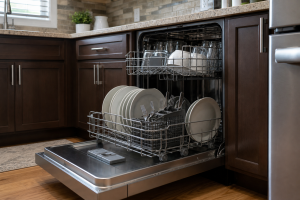
Seeing **oE** on a Samsung dishwasher narrows the problem to **over-level / too much water error**. What you do next depends on whether the code is an issue, a normal status/test message, or a model-dependent interpretation. Samsung uses overlapping code conventions across model years and regions. This page keeps the appliance context attached to the code so a same-looking string from another product family is not misapplied. The recorded display form is **oE**. Search normalization stores it as **OE** while preserving the characters a homeowner actually sees.
Reviewed by Ethan Mercer · Last reviewed August 17, 2026
Written by
Ethan Mercer Appliance Repair Content SpecialistPublished August 17, 2026Updated August 22, 2026Technically reviewed August 17, 2026
Content status:
Verified
Error codeOE
ApplianceDishwasher
Quick answer
Over-level / too much water error.
Model compatibility: Samsung can reuse or reformat codes across series and model years, so OE may mean something different on another appliance or generation. Confirm this against your model’s documentation and record your full model number before acting.
Plain language
What this code means
Seeing **oE** on a Samsung dishwasher narrows the problem to **over-level / too much water error**. What you do next depends on whether the code is an issue, a normal status/test message, or a model-dependent interpretation. Samsung uses overlapping code conventions across model years and regions. This page keeps the appliance context attached to the code so a same-looking string from another product family is not misapplied. The recorded display form is **oE**. Search normalization stores it as **OE** while preserving the characters a homeowner actually sees.
Signs
Symptoms you may notice
A symptom that fits oE is that the appliance can stop or limit the affected function when the code is detected.
On affected Samsung dishwasher models, the same code can return at a repeatable stage of operation.
A symptom that fits oE is that other symptoms depend on the model and the subsystem named by Samsung.
A symptom that fits oE is that oE appears during the dishwasher function associated with over-level / too much water error.
One clue that supports the oE diagnosis is that the cycle may stop, drain, fail to fill/heat, or repeat a stage.
Why it happens
Possible causes
varies by model — official regional/current support — Over-level / too much water error
Before you call
Safe checks you can make
These are simple, non-hazardous checks only. If anything is unclear, stop and contact a technician.
Before requesting service for oE, record the exact code, model number, and operating stage before resetting power.
With oE recorded, complete only the owner-accessible checks described in the model manual.
Before requesting service for oE, do not replace parts solely from a display code when wiring, conditions, or control feedback can create the same result.
Before requesting service for oE, record the code before resetting.
To rule out an accessible cause, check water supply, drain path/filter, door, detergent/suds, and visible leaks only when relevant.
Before requesting service for oE, if the code reappears after the supported owner checks, request model-specific diagnosis.
Important safety warning. Stop use for active leakage near electrical parts, burning smell, or repeated breaker trips. Do not defeat leak or door-safety switches. If resolving oE would require energized internal access, that is the point to hand the diagnosis to a qualified technician.
Get help
When to request repair service
Once oE has returned after the safe checks, If the code returns after the documented basic checks, request model-specific diagnosis of the affected subsystem. Preserve any accompanying noise, water level, temperature, or operating-stage details for the technician.
Book your repair
Seeing this code on your Samsung appliance?
Book a specialist visit for a clear estimate and approval before any repair.
One controlled restart is reasonable after correcting an obvious external issue. A recurring **oE** display should be treated as diagnostic evidence, not as a reason to keep rebooting the appliance.
Do not keep operating the appliance through a hazardous symptom just to see whether **oE** clears. If there is heat, water, electrical, gas, or food-safety risk, stop and arrange diagnosis.
Treat **oE** as a starting point, not a replacement instruction. Wiring, feedback signals, operating conditions, and electronic controls can mimic a failed component.
The same-looking code can be reused on another Samsung appliance family or reformatted by region/model year. Match the appliance type and exact model before applying a meaning. This page therefore keeps **Dishwasher oE** separate from same-looking codes used by other Samsung appliance families.