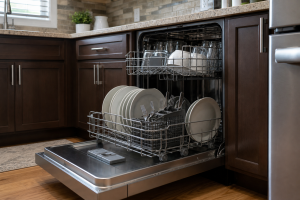
Seeing **tC1** on a Samsung dishwasher narrows the problem to **drying temperature-sensor error**. What you do next depends on whether the code is an issue, a normal status/test message, or a model-dependent interpretation. Samsung uses overlapping code conventions across model years and regions. This page keeps the appliance context attached to the code so a same-looking string from another product family is not misapplied. The recorded display form is **tC1**. Search normalization stores it as **TC1** while preserving the characters a homeowner actually sees.
Reviewed by Ethan Mercer · Last reviewed August 17, 2026
Written by
Ethan Mercer Appliance Repair Content SpecialistPublished August 17, 2026Updated August 22, 2026Technically reviewed August 17, 2026
Content status:
Verified
Error codeTC1
ApplianceDishwasher
Quick answer
Drying temperature-sensor error.
Model compatibility: Samsung can reuse or reformat codes across series and model years, so TC1 may mean something different on another appliance or generation. Confirm this against your model’s documentation and record your full model number before acting.
Plain language
What this code means
Seeing **tC1** on a Samsung dishwasher narrows the problem to **drying temperature-sensor error**. What you do next depends on whether the code is an issue, a normal status/test message, or a model-dependent interpretation. Samsung uses overlapping code conventions across model years and regions. This page keeps the appliance context attached to the code so a same-looking string from another product family is not misapplied. The recorded display form is **tC1**. Search normalization stores it as **TC1** while preserving the characters a homeowner actually sees.
Signs
Symptoms you may notice
The tC1 display becomes more meaningful if the control may stop or limit operation because a temperature reading is missing or implausible.
Depending on the exact model, heating, cooling, drying, or defrost behavior can become inconsistent.
While tC1 is active, the display may return at a similar stage each time the affected sensor is checked.
When the tC1 condition is present, tC1 appears during the dishwasher function associated with drying temperature-sensor error.
While tC1 is active, the cycle can stop, drain, fail to fill/heat, or repeat a stage.
Why it happens
Possible causes
varies by model/region — cross-region baseline — Drying temperature-sensor error
Before you call
Safe checks you can make
These are simple, non-hazardous checks only. If anything is unclear, stop and contact a technician.
The next non-invasive check is to record when the code appears and whether the appliance had just heated, cooled, or defrosted.
Before opening any service area, confirm vents, doors, filters, and ambient conditions are normal where they affect the sensor reading.
As an external check for tC1, use the exact model manual before assuming the sensor itself is defective.
A safe owner-level check is to record the code before resetting.
As an external check for tC1, verify water supply, drain path/filter, door, detergent/suds, and visible leaks only when relevant.
Before requesting service for tC1, if the code returns after the supported owner checks, request model-specific diagnosis.
Important safety warning. Stop use for active leakage near electrical parts, burning smell, or repeated breaker trips. Do not defeat leak or door-safety switches. If resolving tC1 would require energized internal access, that is the point to hand the diagnosis to a qualified technician.
Get help
When to request repair service
Once tC1 has returned after the safe checks, Persistent temperature-sensor codes usually require resistance/connection checks at the sensor, harness, and control—work best done with the model-specific service procedure. Preserve any accompanying noise, water level, temperature, or operating-stage details for the technician.
Book your repair
Seeing this code on your Samsung appliance?
Book a specialist visit for a clear estimate and approval before any repair.
You can try the one reset Samsung documents for the model, but **tC1** returning afterward means the condition still exists. Note the operating stage instead of cycling power repeatedly.
Continue only if the appliance is otherwise safe and the owner-level checks are appropriate. Stop for leakage near electrical parts, smoke, burning odor, arcing, gas concerns, repeated breaker trips, uncontrolled heating, or unsafe temperatures.
Not automatically. Samsung error codes are diagnostic indicators, not part numbers. Confirm the circuit around **tC1** before replacing anything.
The same-looking code can be reused on another Samsung appliance family or reformatted by region/model year. Match the appliance type and exact model before applying a meaning. This page therefore keeps **Dishwasher tC1** separate from same-looking codes used by other Samsung appliance families.