Water around a Samsung refrigerator can come from the household supply, filter housing, dispenser tubing, ice system, defrost drain, condensation, or a door-seal condition. The first place water appears and the timing…
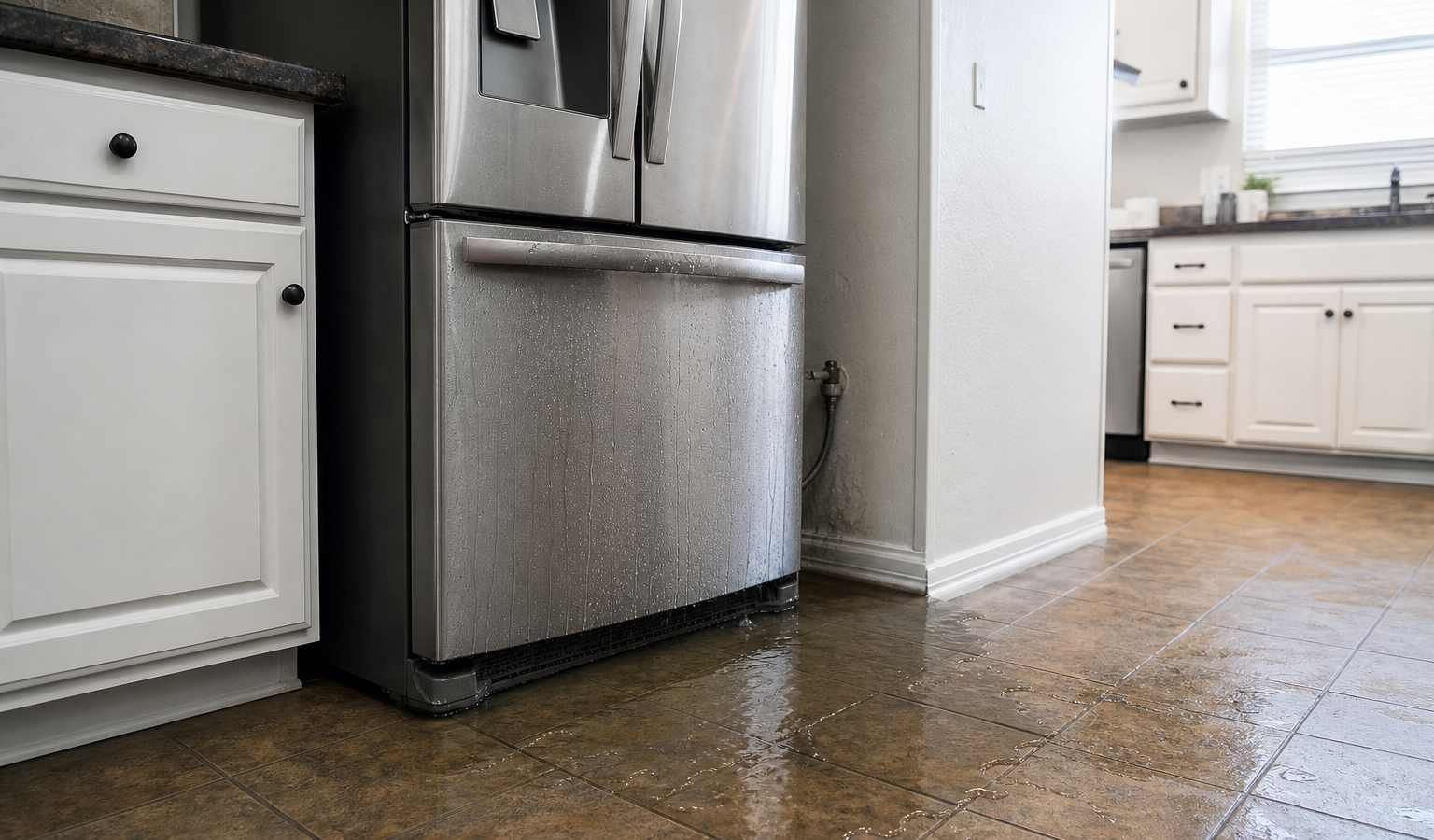
Water under or around a Samsung refrigerator usually starts at one of a few places: the Autofill pitcher, the water filter, the dispenser, or the area beneath the drawers. Dry the spot, watch where moisture returns first, and note whether it follows dispensing, ice making, or defrost. Water that keeps coming back from somewhere you cannot reach calls for a visit.
Water around a Samsung refrigerator can come from the household supply, filter housing, dispenser tubing, ice system, defrost drain, condensation, or a door-seal condition. The first place water appears and the timing of the leak are more useful than the size of the puddle.
Change one condition at a time. If you reset power, change settings, clean several systems, and move the appliance all at once, you lose the evidence that could have narrowed the problem.
Samsung’s leak guidance lists these sources: the Autofill pitcher, the water filter, under the drawers or the refrigerator itself, and the dispenser. On models with Autofill, the page says to remove the rubber drain cap and drain all the water, and to hand wash the pitcher since a dishwasher can warp it. Autofill will not fill when it detects moisture, so a leak around it can also stop the feature.
The refrigerator should tilt slightly backward, so if the front wheels touch the floor the front needs raising.
Samsung refrigeration spans French-door, side-by-side, top-freezer, bottom-freezer, counter-depth, Bespoke, Family Hub/connected, ice/water, and several generation-specific control platforms. A code that is correct for one refrigerator family is not automatically applicable to another.
For cooling complaints, the most useful owner data are measured temperatures, frost location, fan/noise changes, ice/water behavior, door closure, and the timing of any power or filter event.
| Symptom | What it can point to | What you can safely check |
|---|---|---|
| Drips at the dispenser after use | Normal drips for several seconds after dispensing | Hold the glass in place for 3 to 5 seconds |
| Water near the filter housing | Filter fit or a non-matching filter | Check the filter type; Samsung describes torpedo and canister styles |
| Puddle under the pitcher area | Autofill pitcher or drain cap | Drain the pitcher and check the rubber cap |
| Water under crisper drawers | Condensation or defrost water path | Check whether it follows a door-seal or frost issue |
| 76C displayed | Samsung lists this as an Autofill water code | Record it; check the pitcher and cap first |
A visible symptom identifies a system to investigate; it does not identify one replacement part. Installation, household utilities, sensors, wiring, mechanical components, electronics, and the appliance’s normal protective logic can create similar outward behavior.
If water returns and the source is not an accessible external connection, the internal tubing, valve, drain, ice system, sensing, or refrigeration-related condensation path may need service.
A repeating symptom deserves model-aware testing rather than a part selected from a generic symptom list.
Samsung says a dispenser drips for several seconds after dispensing as normal behavior, and that holding the glass in place for 3 to 5 seconds helps. The page also says to purge air from the line, that a line should fill 6 oz in under 10 seconds, and that the high pressure range is 30 to 130 psi. Reverse osmosis systems lower the pressure, which can change how the dispenser behaves.
Filter fit also matters. Samsung says genuine Samsung filters come in a torpedo style with a rounded finger grip or a canister style with a serial number and rib. Confirm the type against your manual.
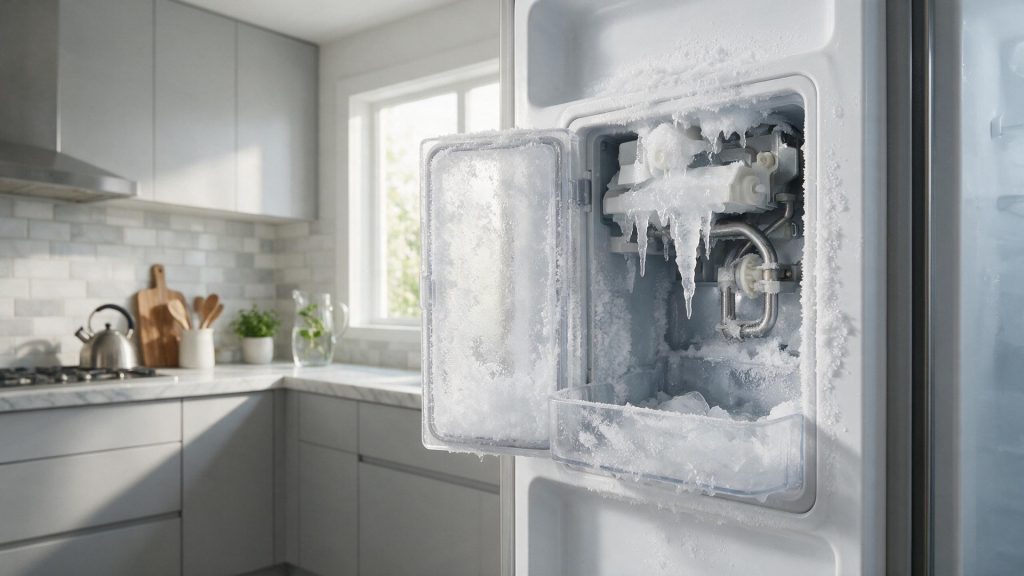
Frost and seal problems can also produce water: Samsung’s frost guidance recommends keeping door openings under 1 minute and about once per hour or less, never using a hair dryer to speed defrosting, and using a flashlight test for seal gaps.
Write down:
– the complete Samsung model code, including a suffix such as `/US`, `/AA`, or `/A3` when the product label includes one;
– the appliance type and installation style;
– the exact symptom in one sentence;
– when it began;
– whether it is constant or intermittent;
– what related function still works normally;
– any displayed code, message, light pattern, or warning before reset;
– any recent power, water, gas, drain, venting, cleaning, filter, or installation event.
Leave built-in, stacked, laundry-hub, or tightly fitted appliances installed unless the service team specifically requests access. Moving an appliance without a plan can disturb flooring, cabinetry, anti-tip hardware, gas, water, drain, venting, or electrical connections.
For condos, high-rises, gated communities, and custom kitchens, include parking/loading, elevator, shutoff, and clearance information when booking.
Do not clear a useful diagnostic display before recording it. Do not replace a part because another Samsung owner reported the same symptom. Do not use a dishwasher code meaning for a washer or range because the characters look similar.
One controlled owner-level check is useful when it answers a question. Repeated resets or panel removal usually removes evidence instead of adding it.
For adjacent symptoms, read Samsung Refrigerator Not Cooling: Separate Airflow, Defrost, and Cooling-System Clues and Samsung Ice Maker Not Making Ice: Temperature, Water, and Harvest Come First.
One normal manual-approved restart can be useful after a temporary control interruption. Record the display first. If the same symptom returns, repeated resets are not a repair.
Usually no. A code narrows the system; it does not always identify one failed component.
No. Keep homeowner checks external and model-appropriate.
Samsung uses many appliance generations and regional/model suffixes. Exact model identity helps prevent the wrong code meaning, wrong procedure, or wrong part path.
Samsung says a few seconds of dripping after dispensing is normal and suggests holding the glass in place for 3 to 5 seconds. Continuous dripping or water on the floor is different.
Samsung lists it as a leak source. Draining it through the rubber cap and hand washing it are the steps its page gives; a dishwasher can warp the pitcher.
No; Samsung says never to use a hair dryer to speed defrosting. Check the door seal and keep door openings short instead.
Book your repair
Book a specialist visit for a clear estimate and approval before any repair.

One normal manual-approved restart can be useful after a temporary control interruption. Record the display first. If the same symptom returns, repeated resets are not a repair.
Usually no. A code narrows the system; it does not always identify one failed component.
No. Keep homeowner checks external and model-appropriate.
Samsung uses many appliance generations and regional/model suffixes. Exact model identity helps prevent the wrong code meaning, wrong procedure, or wrong part path.
An empty Samsung ice bin can come from freezer temperature, water supply, filter condition, fill hardware, a frozen fill path, sensing, harvest components, or…
Uneven browning can come from cookware, rack position, door opening, convection airflow, calibration, a heating component, temperature sensing, or control behavior. One disappointing tray…
A Samsung dishwasher can leave water because of the filter/sump area, drain hose, sink or disposer connection, drain pump, check path, sensing, or control…
Book your repair
Tell us the symptom, appliance and any code you see. We’ll use those details to start with a focused diagnostic path.
Share a few details and we’ll confirm an appointment. Prefer to talk? Call us and we’ll help right away.